
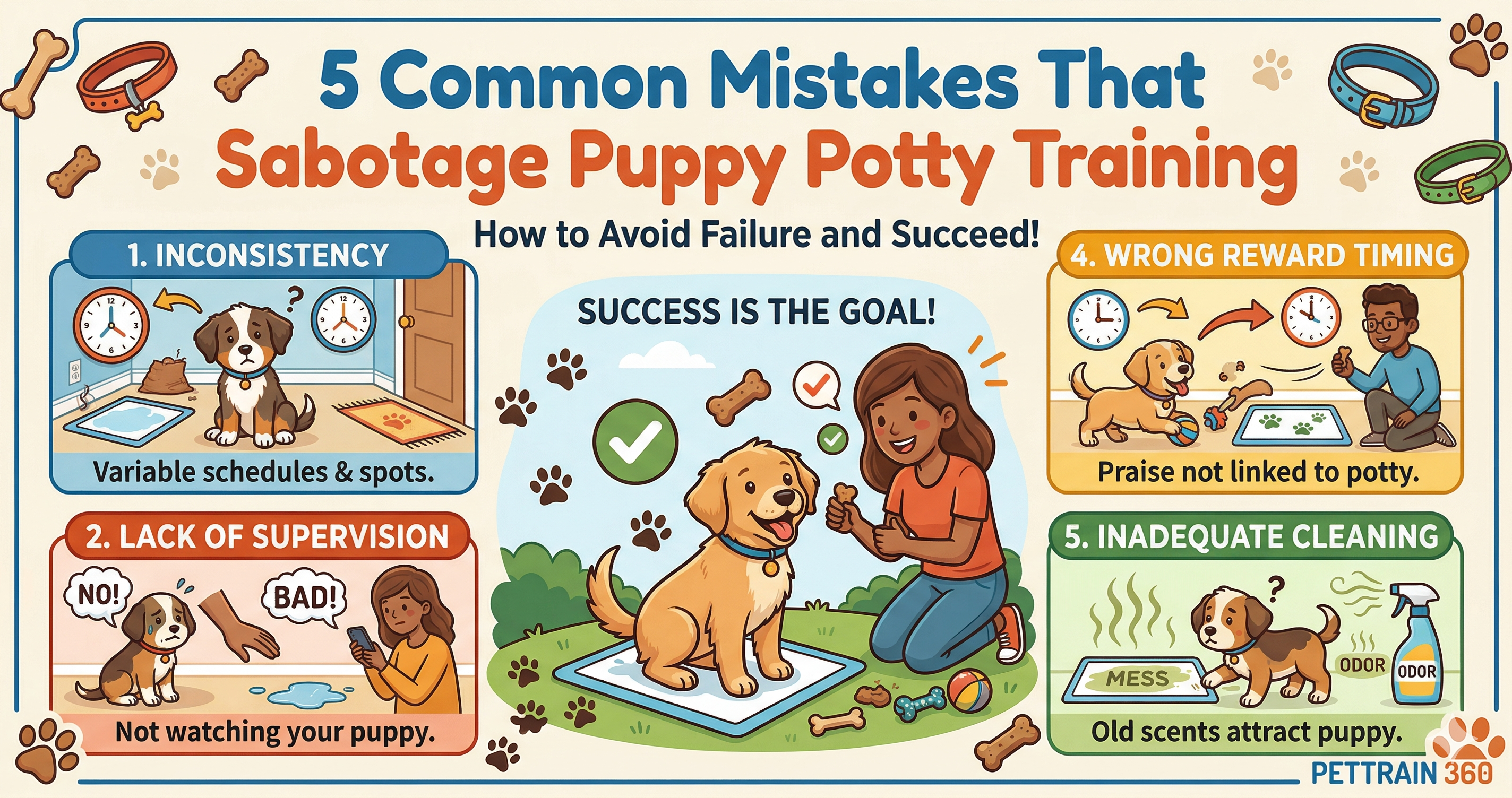
5 Common Mistakes That Sabotage Puppy Potty Training (And How to Fix Them)
Bringing home a new puppy is an incredibly exciting time, but it usually comes with one major stressor: housebreaking. If you feel like you are constantly cleaning up puddles or that your puppy just "isn't getting it," you are not alone.
Here at Pet Train 360, our head trainer Ken has worked with countless frustrated dog owners who are stuck in a cycle of potty training accidents. The good news? Your puppy isn't being stubborn. In most cases, a few simple tweaks to your routine can completely transform your dog's behavior.
If you want to fast-track your success and save your rugs, avoid these five common puppy potty training mistakes.
1. Being Inconsistent with Schedules and Spots
Puppies thrive on predictability. One of the biggest mistakes new owners make is feeding their puppy at random times and taking them out through different doors to different parts of the yard.
When a puppy's digestive schedule is unpredictable, their potty schedule will be, too. Furthermore, taking them to different spots forces them to guess where the "bathroom" actually is.
The Fix: Establish a strict daily schedule. Feed your puppy at the exact same times every day, and take them out immediately after eating, waking up, and intense play sessions. Always take them through the same door to the exact same designated "potty spot" in the yard.
2. Lack of Direct Supervision
A puppy wandering the house unsupervised is a puddle waiting to happen. If you find a mess behind the sofa 20 minutes after it happened, the training opportunity has already been lost. Puppies give subtle signs before they relieve themselves—like sniffing the ground in circles, pacing, or suddenly leaving the room.
The Fix: If your puppy is not in their crate or a safe playpen, you need to have eyes on them 100% of the time. Ken often recommends the "umbilical cord" method: keep your puppy on a leash indoors and attached to your belt. If you can't watch them, they should be in their crate.
3. Punishing Indoor Accidents
We cover this heavily in our Foundations of Positive Reinforcement module, but it bears repeating: never yell at, swat, or rub your puppy’s nose in their mess.
If you yell at your puppy for peeing on the rug, they don't learn that peeing inside is bad. They learn that peeing in front of you is dangerous. This leads to a dog that hides in closets or behind furniture to go to the bathroom.
The Fix: If you catch them in the act, quickly interrupt them with a firm but calm "Oops!" and immediately carry them outside to their potty spot. If you find an accident after the fact, simply clean it up. Punishing after the fact is completely ineffective because dogs do not connect past actions with current punishments.
4. Wrong Reward Timing
Positive reinforcement is the fastest way to train a dog, but timing is everything. Many owners wait until the puppy finishes going potty, walks back to the house, and comes inside before handing over a treat. By that time, you aren't rewarding the puppy for going potty—you are rewarding them for walking through the door!
The Fix: The reward must happen within three seconds of the desired behavior. Keep high-value training treats in your pocket. The exact second your puppy finishes doing their business in the grass, offer enthusiastic praise and hand them a treat while they are still standing in the potty spot.
5. Inadequate Cleaning (The Invisible Trigger)
Dogs experience the world through their noses. Their sense of smell is up to 100,000 times more sensitive than ours. If your puppy has an accident and you clean it with standard household soap or bleach, it might smell clean to you, but your puppy can still smell the uric acid. To them, that lingering scent screams, "This is the bathroom!"
The Fix: You must use an enzymatic cleaner. Enzyme cleaners actually break down the proteins and bacteria in pet waste at a molecular level, completely eliminating the scent. Saturate the accident area thoroughly, let it sit for the recommended time, and blot it dry.
Consistency is the Key to a Clean House
Potty training doesn't happen overnight, but by avoiding these five mistakes, you will dramatically shorten the housebreaking phase. Remember to supervise closely, manage their schedule, and always reward the wins!
Ready to take your training to the next level? Whether you are mastering housebreaking or moving on to advanced obedience, the Pet Train 360 Library has you covered. Log in to your dashboard today to start the Core Commands and Life Skills module and start earning your training badges!