
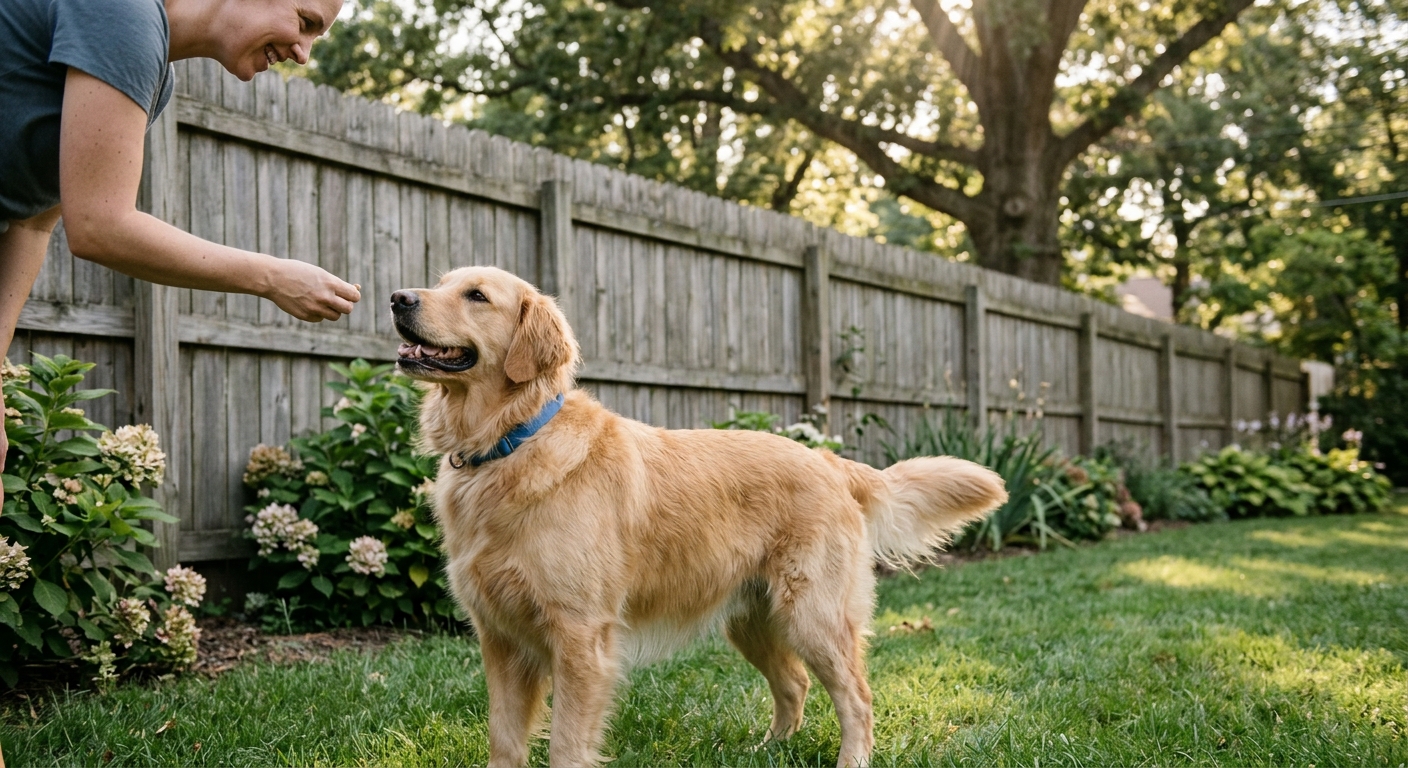
An online dog obedience course teaches the everyday skills most owners want — sit, down, stay, come, polite greetings, and walking without a wrestling match — through structured lessons you can run at home. PetTrain360 offers a Free plan at $0 and a Pro plan at $8 per month, billed monthly (live pricing checked November 16, 2026). Create an account to start, then follow the lessons at your dog's pace.
Obedience is not a show-ring hobby for most households. It is how a dog lives with people: waiting at the door, coming in from the yard, sitting instead of jumping on a guest, and settling when the house is trying to be quiet. An at-home course is a fit when you want that structure without commuting to a weekly class, or when your dog practices better in the rooms where the problems actually happen.
What a solid online obedience course should cover
Look for lessons that build on each other instead of a pile of unrelated clips:
- Attention and name response
- Sit, down, and a real stay, not a one-second pause
- Come when called, starting in easy rooms and moving to more distraction
- Loose manners at doors, gates, and mealtimes
- Polite greetings, including the jumping problem that shows up when company arrives
- A plan for short daily sessions, because long weekend "catch-up" training rarely sticks
PetTrain360 is built as an at-home course platform with a free starting option and a Pro plan if you want the fuller lesson library. The online puppy training course and rescue dog training online guides explain how age and history change the plan. This article is the obedience path itself: the shared manners every pet dog needs, whether you adopted last month or years ago.
Why at-home lessons often stick better than a once-a-week class
A classroom is useful for coaching and for some kinds of distraction. It is not where your dog eats, greets delivery drivers, or rushes the door. If you only train on a mat in a park once a week, the door manners at home barely change. Short, frequent sessions in the kitchen, the hallway, and the front step are how cues start to mean something in real life.
Online lessons also let you repeat a step without waiting for the next class, and they let a second family member watch the same demonstration so the household is not giving three different signals. That consistency matters more than any single "perfect" rep.
If your dog is new to the home, pair obedience with the settling and routine work in our rescue dog training guide. If the main issue is the dog disappearing into a panic when you leave, that is a different plan; see separation anxiety training online.
A practical four-week starting shape
You can adjust the pace, but a simple first month looks like this:
Week 1. Name response, sit, and a short "wait" for the food bowl. Keep sessions to a few minutes. End while the dog is still willing.
Week 2. Down, a slightly longer stay, and door waits. Practice when nothing exciting is on the other side of the door before you add guests or packages.
Week 3. Recall in the house and a fenced yard, if you have one. Do not test a brand-new come on an open sidewalk.
Week 4. Greetings and a short loose-leash segment on a quiet walk. If jumping is the household's main complaint, give that its own daily set of reps rather than burying it at the end of a long session.
Tricks can wait until the basics are reliable. When you do want them, dog trick training online is the companion path, not a replacement for sit and come.
How PetTrain360 fits into a normal week
Register and start on the Free plan if you want to look around at $0. The Pro plan is $8 per month, billed monthly, as shown on pricing on November 16, 2026. Use the lessons as a calendar, not as a binge. Five or ten minutes most days will beat a one-hour Sunday project.
You supply the rewards, the leash, and a quiet starting place. The course supplies the sequence and the demonstrations. If a step falls apart, go back one lesson instead of skipping ahead to a more impressive cue. Obedience built on a shaky stay just becomes a dog that guesses.
Family training works when everyone uses the same words and the same criteria. Watch a lesson together once, then take turns running the short sessions. Children should only train with an adult's plan; the course is not a substitute for supervising kids and dogs.
What an online course cannot replace
Some problems need a qualified in-person professional: a dog that has bitten, a dog that cannot be safely walked, or a situation you do not feel safe handling at home. An obedience course is the wrong only tool in those cases. Choose a professional who uses modern, humane methods, and use online lessons later for the everyday skills around that work.
An online course also cannot socialize a puppy by itself. It can give you structure. Real-world practice, careful introductions, and vet guidance still matter. For young dogs, stay close to the puppy course and a sensible weekly routine.
Rewards, equipment, and a realistic daily rhythm
You do not need a special training collar to run an obedience course at home. A flat collar or a well-fitted harness, a leash, and rewards your dog will work for are enough to start. If you use food, break it into small pieces and count it as part of the day's meals so you are not accidentally overfeeding. If your dog is more toy-motivated, use a short tug or a brief fetch as the payday, then go back to calm.
Time of day matters. A dog who has been in a crate or alone for hours may need a toilet break and a little movement before a sit-stay will look anything like the video. A dog who has just finished a wild play session may also be a poor student. Tuck the lesson into a predictable slot: after a short walk, before dinner, or during a quiet mid-evening stretch. The cue words should be the same every time. If one person says "come" and another says "here," the dog is not being stubborn. The household is being unclear.
Write the week's plan on a note on the fridge if that helps the family stick to it. The note only needs three lines: which lesson, how many short sessions, and what "good" looks like (for example, "a sit that lasts until we say the release word"). That is enough structure for most households, and it keeps the course from turning into a video you meant to watch.
Frequently asked questions
Is an online dog obedience course enough for a pet dog?
For everyday household manners, a structured at-home course plus daily practice is enough for many families. It is not a substitute for in-person help when safety is in question.
How much does PetTrain360 cost?
The Free plan is $0. The Pro plan is $8 per month, billed monthly, as listed on the pricing page on November 16, 2026. Start at register.
How long should obedience sessions be?
Short and frequent. A few minutes of good work is better than a long session that ends in frustration. Stop while the dog is still engaged.
Can I train an adult dog, or is this only for puppies?
Adult dogs can learn the same cues. The pace and the motivation may differ, and some habits will take more repetition. See our adult-dog training guide if that is your situation.
What if my dog is too excited to learn in the house?
Start in the quietest room, lower the difficulty, and train before a walk or play rather than immediately after a chaotic arrival. If arousal never comes down, get qualified in-person advice.
Will tricks get in the way of obedience?
Not if you keep the basics strong. Teach tricks after sit, down, stay, and come are reliable, or keep trick sessions separate so they do not replace manners work.
Start household obedience at home
A well-mannered dog is mostly a practiced dog. PetTrain360 gives you an online dog obedience course you can run in the rooms where life actually happens, with a free way to start and a Pro plan at $8 per month. Register and begin with the first short session today.